

▪ Crisis-era Federal Reserve policies helped keep interest rates unusually low
▪ Inflation, government borrowing, and investor demand also shape rates
▪ Higher rates can increase savings income and borrowing costs
▪ Companies with substantial debt may face greater financial pressure
Unusually low interest rates shaped the global economy for much of the past two decades, but how much of that environment reflected genuine market forces rather than extraordinary central bank monetary policy?
Monetary policy refers to the actions and strategies used by a country’s central bank to promote economic stability. Central banks influence financial conditions through several key tools, including interest rates, the money supply, and commercial bank reserve requirements. In the United States, these responsibilities fall primarily to the Federal Reserve. Over the past 20 years, however, two major economic disruptions tested monetary policy: the Global Financial Crisis (GFC) and the COVID-19 pandemic. In response, central banks implemented measures that dramatically altered financial conditions and contributed to an extended period of historically low interest rates.
The modern interest-rate environment was shaped by two extraordinary economic shocks. In 2007–2008, the Global Financial Crisis (GFC) prompted the Federal Reserve to cut interest rates to near zero and launch a large-scale quantitative easing program (see Chart 1). In simple terms, the Fed sought to make capital more accessible, encouraging borrowing, investment, and economic activity at a time when financial markets were under severe stress.
These policies helped Japan manage a government debt burden that eventually grew to more than 200% of GDP. But that environment is now changing. Inflation returned, monetary policy is normalizing, and in September 2026, Japan’s 10-year government bond yield moved above 3% for the first time since 1996 (see Chart 2).
Chart 1

Just over a decade later, the global pandemic triggered another unprecedented response. In 2020, the Federal Reserve dramatically expanded its balance sheet and once again pushed interest rates toward zero, providing substantial liquidity to financial markets and the broader economy (see Chart 1). While these policies helped stabilize economic activity during periods of significant disruption, they also contributed to an extended period of exceptionally low-cost capital.
With the recent Fed balance sheet reduction (referred to as “quantitative tightening”) and the move away from extraordinary liquidity (no more 0% interest rates or 2.5% mortgages), it begs the question of whether a more traditional “market-driven” trend is emerging. This shift does not mean that the Federal Reserve has stopped influencing interest rates. Rather, the relative influence of other economic forces may be becoming more apparent, such as inflation expectations, government borrowing needs, the balance between savings and investment, and investor risk premiums.
Japan provides an interesting case study because its era of ultra-low interest rates began well before the GFC and COVID-19. Following the collapse of its asset bubble in the early 1990s, Japan struggled with weak growth and persistent deflation. The Bank of Japan eventually pushed interest rates to zero and later used negative rates and large-scale bond purchases to keep borrowing costs exceptionally low.
Chart 2

Japan provides a simple lesson: keeping rates extremely low can make large debt burdens easier to manage, but reversing those policies becomes much harder once borrowing costs begin to rise.
The recent rise in U.S. interest rates reflects several forces. Economic growth remains solid, inflation is still above the Federal Reserve’s target, and large federal deficits require continued Treasury borrowing. Together, these factors put upward pressure on interest rates even as policymakers look for ways to ease strains in the bond market.
Recent efforts by Treasury Secretary Scott Bessent to expand Treasury buybacks provide a useful example. Buybacks can improve liquidity in parts of the Treasury market, but they cannot eliminate the broader forces determining interest rates. Ultimately, investors still need to be compensated for inflation, fiscal risk, and the opportunity cost of lending money to the government.
Ultimately, higher interest rates are not inherently negative. They can restore an important source of income for savers and investors by increasing the yields available on cash and high-quality fixed-income assets. Retirees and other income-focused investors are no longer forced to accept near-zero returns on relatively safe investments, while savers once again receive greater compensation for delaying consumption.
However, the benefits of higher rates come with meaningful trade-offs. As the cost of capital rises, mortgages become more expensive, corporate borrowing costs increase, and consumers face higher costs on new and existing debt.
The same arithmetic applies to governments, but with one important difference today: the U.S. is returning to more normal interest rates with a much larger debt burden. Before the GFC, federal debt held by the public was roughly 35% of GDP. Today, it is around 100% (see Chart 3).
Chart 3

That makes higher interest rates more consequential. As existing debt is refinanced at higher borrowing costs, interest expense can consume an increasingly large share of government resources. In other words, interest rates may be returning toward historically normal levels, but the amount of debt those rates are being applied to is anything but normal.
It is also worth keeping the recent rise in perspective. Today’s interest rates may feel high relative to the unusual lows of the post-GFC and pandemic years, but they are not historically extreme. The 10-year Treasury averaged well above today’s levels throughout much of the 1980s, 1990s, and early 2000s. Rather than viewing today’s rates as unusually high, the better perspective may be that the exceptionally low cost of capital of the past 15 years was the historical anomaly.
At GHP Investment Advisors, Inc. we view the end of the era of near-zero interest rates as a constructive development for long-term investors. With yields at more sustainable levels, investors can once again earn meaningful income from fixed income.
At the same time, a higher cost of capital has important implications for equity investors. Higher interest rates can pressure valuations and place greater strain on companies with excessive debt, increasing interest expense, reducing financial flexibility, and potentially creating greater volatility in earnings and share prices. This is why, at GHP Investment Advisors, Inc., we maintain valuation benchmarks, factor financial risk and balance sheet health into our investment process, and focus on companies with solid fundamentals and the financial strength to withstand a more normal interest-rate environment.
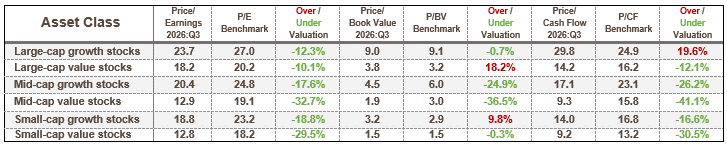

GHP Investment Advisors, Inc. Benchmarks are determined using any combination of valuation approaches deemed relevant by GHPIA, including Price to Earnings (P/E), Price to Cash Flow (P/CF), and Price to Book (P/B), and other relevant analyses. Consideration is given to such factors as historical and projected financial growth for the company, profit stability, leverage, the quality of earnings, valuations of comparable companies, the size and scope of the company’s operations, the strengths and weaknesses of the company industry information and assumptions, general economic and market conditions, and other factors deemed relevant. While Benchmarks are based on valuations and assumptions that GHPIA believes are reasonable under the circumstances, actual realized returns on such investments may differ materially and do not take into account any fees or expenses that may be associated with investing in those assets. There is no assurance that the investment objectives and strategies described herein will be achieved or successful. P/E, P/BV, and P/CF data are provided by FactSet.
Investment Insight is published as a service to our clients and other interested parties. This material is not intended to be relied upon as a forecast, research, investment, accounting, legal, or tax advice, and is not a recommendation, offer or solicitation to buy or sell any securities or to adopt any investment strategy. The views and strategies described may not be suitable for all investors. Individuals should seek advice from their own legal, tax, or investment counsel; the merits and suitability of any investment should be made by the investing individual. References to specific securities, asset classes, and financial markets are for illustrative purposes only. Actual holdings will vary for each client, and there is no guarantee that a particular account or portfolio will hold any or all of the securities listed. Past performance is no guarantee of future results. Investments carry risk and investors should be prepared to lose all or substantially all of their investment.

Top Row L to R: Brad Engle, Mike Sullivan, Sebrina Ivey, Christian Lewton, Jason Kitner
Bottom Row L to R: Carin Wagner, Angela Kennedy Lee, Jenny Merges, Brian Friedman, Deirdre Mcguire, Barbara Terrazas, Reed McCoy
